"...the common talk goes in the district that Captain Jöran Pålman [Polman] at that time was courting Mrs. Beata Lilliesparre at Sunnaryd..."
— Vice-Governor Peder Månsson Lood, October 4, 1635
The man who spoke those words did so quietly, the day after the formal court session had closed. It was not a statement for the record. No one at the Västbo district court that week would put their name to it under oath. And yet the Vice-Governor documented it anyway — because what he had heard, and what lay beneath it, was too consequential to simply let pass.
Twelve years before these words were spoken, an old woman in the village of Sunnansjö had been called to a lady's house and coaxed into keeping a secret. By 1635, that secret had become bones in a loft, a dead child in a copper pot, a village buzzing with accusation, and a nobleman's flight from the realm. The woman at the centre of it all — Beata Lilliesparre — would spend years fighting for her name in courtrooms bouncing the case between district and appellate authority, until a verdict finally came in 1639.
The child at the heart of it would never have a name to fight for.
"An Evil Name Spread About Her": The First Hearing (May 1633)
The case first reached the courts in 1633. On May 3 of that year, Beata Lilliesparre's brothers — Arvid Lilliesparre af Samseryd and Olof Lilliesparre af Fylleskog — arrived before the Västbo district court alongside their sister and filed a complaint.[[1]] The language of the record is blunt: an evil name (ondt Nampn) had spread through Sunnansjö concerning Beata and "a child or a pile of small bones, which are found in Sunnansjö."[[2]]
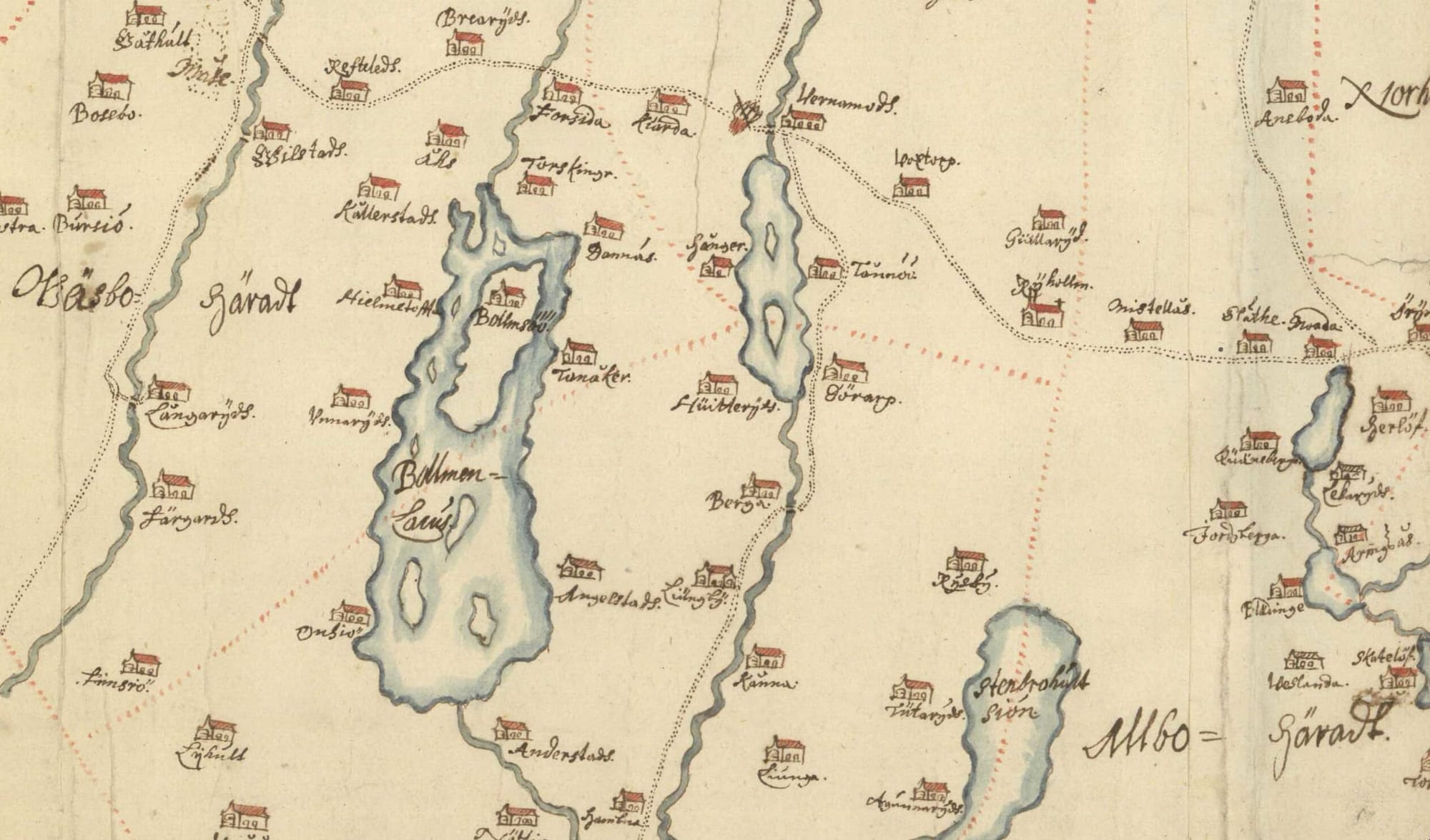
The siblings were not confessing. They were suing for their family's reputation. But the complaint itself, in naming the rumour in order to dispute it, placed the accusation formally before the court for the first time. The court immediately turned its attention to the woman who, it was said, had started the talk.
Her name was Elin Nilsdotter. She was old, frail, and by her own account unable to travel to court. On May 3, the authorities had assembled at Brogård on Bolmsö island to interrogate her — a full investigation (fullkombligha förhörd) conducted, as the record states, "on behalf of the authorities."[[3]]
What Elin told them that day formed the backbone of everything that followed.
Yet the hearing did not proceed to judgment. Arvid and Olof, having filed the complaint, now intervened: the old lensman must be present before proceedings continued, they said, and they would not submit to any lesser hearing.[[4]] The case was adjourned. The brothers had come to court to clear their sister's name — and then ensured the court could not move against her.
"Ill-Rumoured for Child-Murder": The Second Hearing (September 1633)
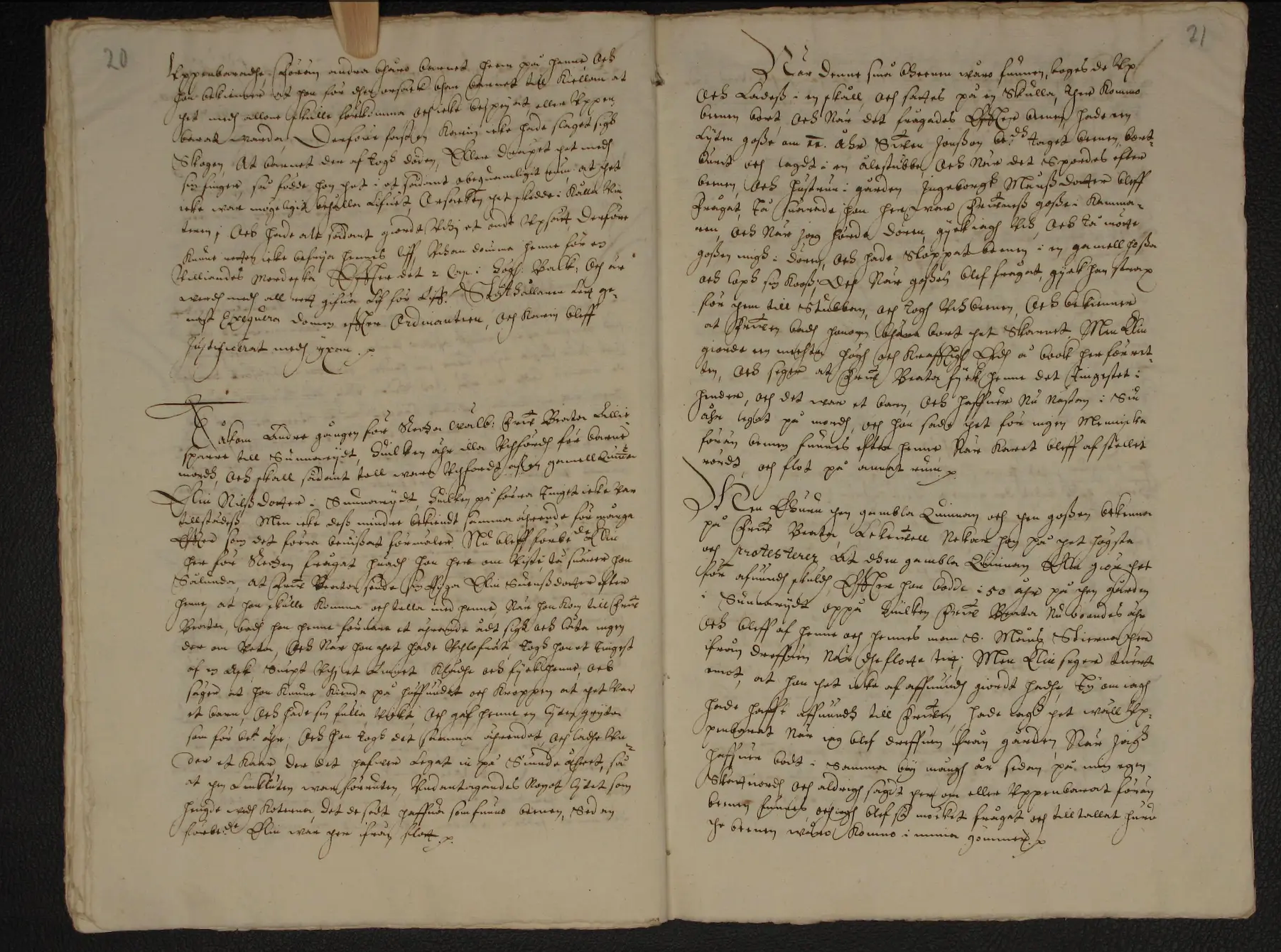
The court session that heard Beata Lilliesparre's case for the second time — convened on September 16–17, 1633 — had already passed judgment for someone else that same day. On the page immediately preceding Beata's, the court recorded its verdict on a woman named Karin Andersdotter:
"...she immediately after she bore the Child to the World did by all means cause the child to perish... the Woman was not able to excuse herself that the Child died of itself... therefore Can she not be freed her life, But is judged a willing murderess... And the Woman was Justified with the axe."[[6]]
— Västbo Häradsrätt, 1633
The charge against Beata Lilliesparre was the same.
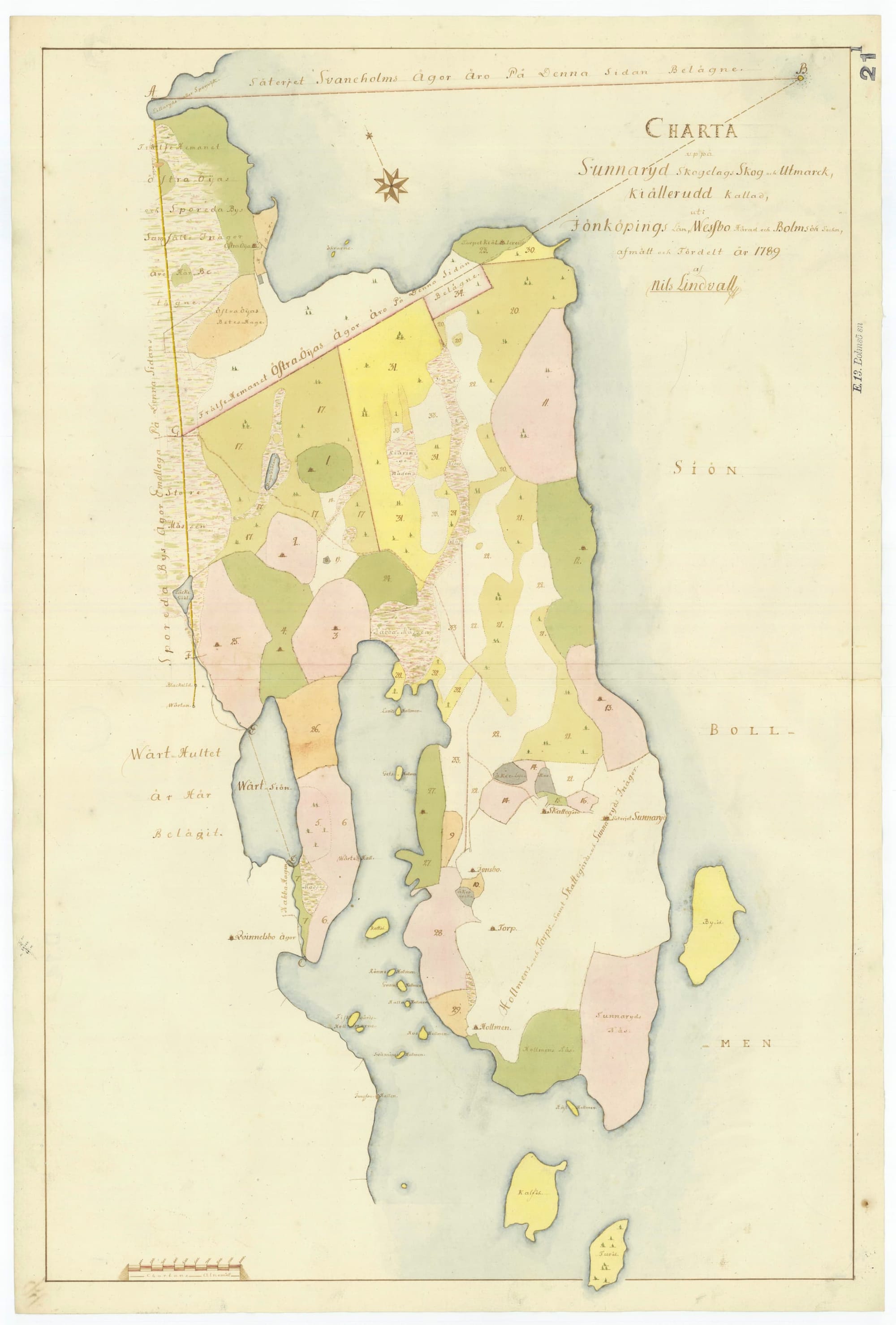
Elin Nilsdotter had lived for fifty years on the estate at Sunnaryd before being driven out when Beata and her late husband, cavalry captain Måns Stierna, moved in. Stierna had died in 1622.[[5]] The displacement was a fact that would later become a weapon against her: Beata's defence insisted the old woman was acting out of envy, motivated by a half-century of removal. Elin denied it flatly: "If I had had envy toward the Lady, had I that well revealed when I was driven from the farm," she told the court. "But I have lived in the same village many years since on my own tax-land and never said it or revealed it before the bones were found."[[7]]
A maid was also called. She told the court that she had been sent to fetch Elin — to come and help a woman. When Elin arrived, Beata had summoned her with many loving and flattering words (många Kierligha och Smijekiande ordt) and asked her to keep a secret.[[8]] After Elin promised, she was shown a bundle taken from a bed: wrapped in a cloth, lying beneath a cushion. She could feel on the head and body that it was a child. It had its full shape. Along with the bundle came a small copper pot. Beata pressed her — with gifts and assurances — to ensure the dead child would "never come into any human's sight."[[9]]
She took the child, placed it beneath a vessel, and left it there. By the time the bones were found, they had lain in the earth for nearly ten years.
Elin complied. She took the child, placed it beneath a vessel, and left it there. By the time the bones were found, she told the court, they had lain in the earth for nearly ten years.
There was one crucial piece of testimony she added — the detail on which the entire case would eventually rest. When asked about the child's condition at the time she received it, she said it was dead, but also that "the child had not had life previously" (barnet hade intet haft lijf tillförenne) and "had not its full shape and growth."[[10]] This was significant. Under Swedish law of the period, barnamord (child murder or infanticide) required proof that the child had been born alive.
Jon Bengtsson, a peasant in Sunnansjö, had found the bones on the floor of a chamber — a skull, and children's bones — and brought in the leaseholder and a local man to examine them. They placed the bones in a vessel and set them on a loft (skullen) to keep them away from the pigs. Then the bones disappeared.
The trail that follows the bones is, by any measure, peculiar. A boy of about eight years — identified in the records as possibly named Sigfrid Jonsson — had taken the bones from the loft, carried them away, and hidden them inside a hollow tree stump. When confronted, he led the authorities directly to the stump and retrieved them. His explanation for the theft was surprising: he said the priest had asked him to carry the child away.[[11]] The priest denied it. But the boy knew no one else to name, and he stuck to his account.
The bones themselves were eventually retrieved and brought before the court by the lensman Jöns of Kållerstad.
Elin made a very high and serious oath before the court (en mykit högh och Alffwarligh Edh å book). She declared that Lady Beata had placed that bundle in her hands, that it was a child, and that it had lain in the ground for nearly ten years.[[12]] She said she had told no one before the bones were found. And she would not waver from that testimony.
The charge had by now sharpened into explicit language. Beata Lilliesparre was described in the court record as someone "ill-rumoured for child-murder" (illa Rychtadt för Barna mord).[[13]]
Her defence had two pillars. The first was character: she produced twelve honest men (Ärlige Dannemänner) prepared to swear on oath that she was innocent of fornication (lönnske-läger, meaning secret lying) and of child-murder.[[14]] These twelve men were her community's most formal public endorsement.
The second was procedural: because she was a noble person (Adels person), the district court declared itself unable to issue a final judgment. The case was forwarded, undecided, to the Göta Court of Appeal — the Hovrätt — along with the record of the investigation.[[15]]
The case had outgrown its local setting. It was now a matter for the appellate court in Stockholm.
"What She Has Said, She Has Said": Referred Back (October 1635)
The Göta Hovrätt sent the case back down to Västbo with specific questions to be resolved. The most important among them: was the child newborn (Nysödt) when Elin Nilsdotter received it?
By the time the reinvestigation was conducted, in October 1635, Elin Nilsdotter was dying. She lay bedridden at Toftanäs, speechless. Her sons, Olof Nilsson and Nils Nilsson, were called instead. They testified separately, each swearing on oath, that their mother had never retracted her original confession — not once, in all the years since.[[16]]
They could not answer the question about whether the child was newborn, because, they said, their mother herself had not known. But they confirmed what she had told the court before: that Beata had delivered to her a dead child wrapped in linen, a child that "had its full size as a full-term child usually has."[[17]] This sits in direct tension with what Elin herself had testified at the 1633 hearing — that the child had not had life previously and lacked its full shape and growth. The contradiction is not resolvable from the record. Three possibilities present themselves: Elin had revised her account between 1633 and her deathbed; her sons remembered or transmitted it differently; or the two descriptions were addressing distinct questions — the child's physical form and the question of live birth being matters the courtroom language may have compressed together. What the record cannot tell us is which version the Göta Hovrätt chose to believe — or whether the contradiction itself was precisely the problem.
The vicar of Bolmsö, Mr. Anders Jonæ, came forward separately to testify. He stated under oath that when he had most recently administered the sacrament to Elin Nilsdotter — the last rite of the dying — she had stood by her words in full. Her exact statement to him: "What she has said, she has said."[[18]] Even on her deathbed, Elin did not recant.
"What she has said, she has said." — Elin Nilsdotter, to the vicar of Bolmsö, on her deathbed at Toftanäs.
She died, so far as the record implies, holding to that confession.
This story came from the archive.
Polmanarkivet is a digital archive dedicated to six centuries of Polman, Påhlman, and von Pohlmann history — researching what survived, and recovering what was buried. Become a free Member and get new research and stories like this one delivered to your inbox every month.
"Meant to Serve the Lady's Will": The Forged Testimony
Against the dying woman's steadfastness, Beata Lilliesparre had earlier produced a document: a written witness statement signed by the chaplain, Mr. Johan, which purported to show that Elin had recanted — that she had been aged and confused, and that her confession could not be trusted. Under examination at the 1635 reinvestigation, this document collapsed entirely.
The players in its fabrication were three. First, the chaplain himself, Mr. Johan: when questioned, he confessed freely that he had not been at Toftanäs on the occasion described. He had written the witness note not from anything he had witnessed, but from what his mother had told him, and at Beata Lilliesparre's explicit request. He asked the court's forgiveness for acting out of "youth's ignorance."[[19]]
She admitted in court that she had done this because she "meant to serve the lady's will."
His mother — Märta Jönsdotter, wife of the old priest — was the second. She had visited Elin alone at Toftanäs, been inside the cottage for a while, and reported back a recantation. She admitted in court that she had done this because she "meant to serve the lady's will."[[20]] No one else could corroborate what had passed between the two women. She got no witness with her to confirm the words she claimed to have heard.
The third figure is Bengt of Sunnaryd — one of Beata's own servants, who had rowed Märta to Toftanäs on Beata's orders. He testified that when he entered the cottage afterward, the only thing he heard Elin say was: "I know not what my sons want to frighten me."[[21]] No recantation. No change of heart.
Every man listed as a witness on the chaplain's document denied being present when it was written. Jöns in Lyda swore he had not spoken with Elin in twelve years.[[22]] Neither of Elin's daughters-in-law, Kirstin and Botill, had been there. Jöns in Bråxa was sick and absent, and his wife confirmed he had not been at Toftanäs.[[23]] The fabrication was total: the chaplain had not been present, the named witnesses had not been present, and the only person who claimed to have heard the recantation was a woman acting at Beata's request who could produce no corroboration.
The investigating clerk, having exhausted the witnesses available within the district, referred the matter back to the Göta Hovrätt in all humility — noting only that the "highly wise lords and well-understanding men in the royal court of appeal" should determine what ought further to be done.[[24]]
"Common Talk in the District"
It was at the close of this same 1635 session that the name Jöran Polman entered the record.
On October 4, the day after the formal proceedings closed, Vice-Governor Peder Månsson Lood spoke privately with Captain Erich Axelsson and the district bailiff Anders Oloffsson. He told them what he had heard but could not formally record at the session: the rumour that Captain Jöran Pålman (Polman) had been courting Beata Lilliesparre at Sunnaryd at the relevant time.[[25]]
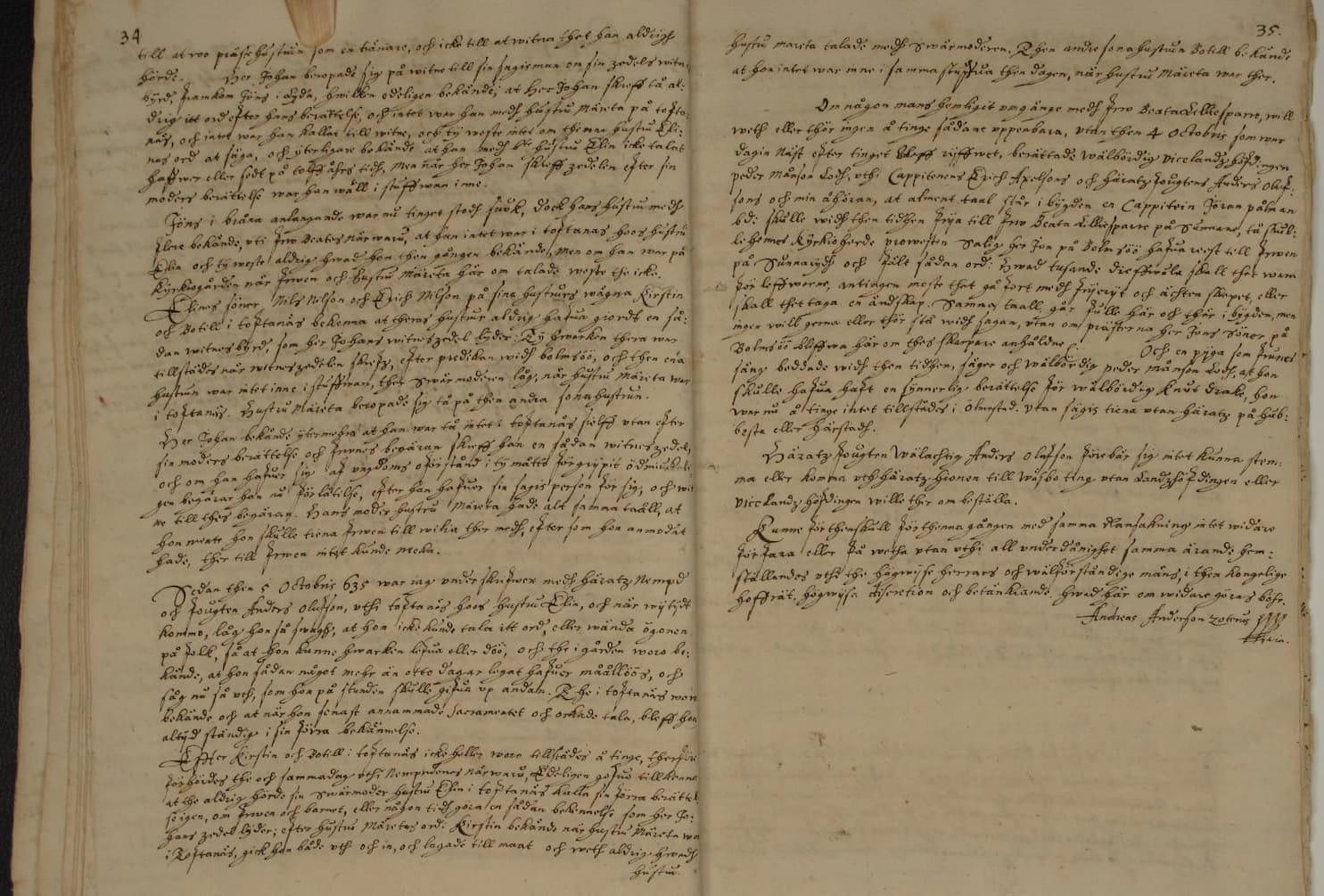
The word used — frija — means to court, to woo, to seek in marriage. But the context gives it a darker weight: Beata's husband was dead, and the district was already buzzing with the accusation that a child had been conceived and hidden.
The vicar had reportedly traveled to Beata's estate and delivered an ultimatum: "What the thousand devils kind of living shall this be — either it must go fast with the courtship and the marriage, or it must come to an end."
The late vicar-provost of Bolmsö, referred to only as "the late Mr. Jon," had apparently taken the situation so seriously that he had made a personal visit to Beata's estate to deliver a direct ultimatum to the pair:
"What the thousand devils kind of living shall this be — either it must go fast with the courtship and the marriage, or it must come to an end."[[26]]
— Vice-Governor Peder Månsson Lood, recounting the vicar's words, October 4, 1635
The gossip had spread so widely that it reached the local clergy. No witness at the court session, however, was willing to state any of this under oath. The Vice-Governor himself could only report it as "common talk" (alment tahl), circulating widely in the district but unattributed. He noted that the vicar's sons, still living on Bolmsö, might know more — if pressed harder. The bailiff explained that he lacked jurisdiction to compel testimony from witnesses residing outside the district without the Governor's intervention. The investigation stalled.
"A Just Verdict": The Royal Mandate (1638)
For three years, the case sat between courts. The Göta Hovrätt in Jönköping, which had been established in the interim, initially refused to accept the documents — returning them unopened to Stockholm.
In October 1638, a royal mandate from the regency government of Queen Christina was issued, addressed directly to the President and Assessors of the Göta Hovrätt in Jönköping:
"And so that the touched-upon case may be properly taken up without further delay, and brought to a conclusion: Therefore We graciously find that such [a case] belongs within its proper venue, the Court of Appeal [in Jönköping], inasmuch as it has been investigated down there at the lower court, since witnesses and reasons/evidence can be closer at hand, and so that the parties do not need to be burdened with long and costly journeys."[[28]]
— Royal Mandate to Göta Hovrätt, October 8, 1638
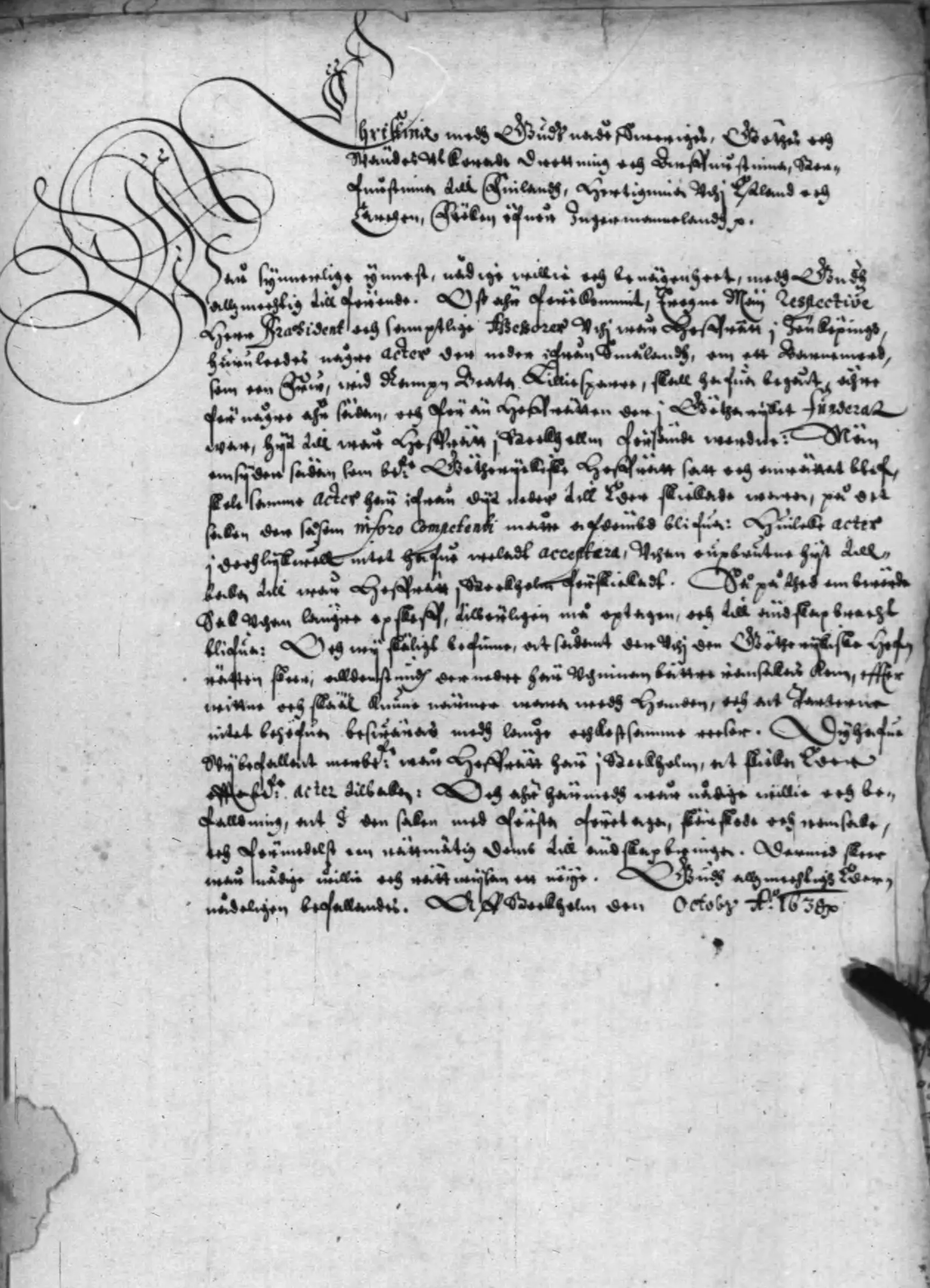
The mandate was unambiguous. The regency government commanded the court to "take up this case at the first opportunity, interrogate and investigate, and by means of a just verdict bring it to an end."[[29]] The authority of the Crown, once set in motion, could not be deflected again by administrative reluctance.
The Verdict
There was one dimension to the case that the mandate does not mention. Beata's brother, Arvid Lilliesparre af Samseryd, had been appointed Assessor of the Göta Hovrätt on November 28, 1635 — the very court now commanded to judge his sister.[[30]] What is certain is that by the time the case reached its final hearing, one of the court's own assessors bore the name Lilliesparre.
On November 7, 1639, the Göta Court of Appeal issued its verdict. Beata Lilliesparre was acquitted of the charge of infanticide.[[31]]
The sources do not preserve the court's reasoning. Three possibilities present themselves. Elin's own original 1633 testimony — that the child had not had life previously and lacked its full shape and growth — offered the judges a basis for concluding that no live child had ever existed, and therefore that no murder had been committed. Alternatively, the exposure of the forged witness statement, with its total collapse under examination, may have so undermined confidence in the available evidence that a conviction could not be sustained. And Arvid Lilliesparre sat on the bench. No evidence survives of improper influence; the sources do not record whether he recused himself or participated. But the coincidence — a brother on the court that acquitted his sister — is one the record places before us without resolution. The verdict is noted in the genealogical sources with the brevity characteristic of the period: acquitted.
What the record does preserve is the structure of her life afterward. By 1641, Beata Lilliesparre was recorded as still a widow, still living at Sunnansjö.[[32]] The estate she had defended in court remained hers. The name she had fought to clear had, in the eyes of the law, been restored.
Whether the village of Sunnansjö agreed is another matter entirely. Courts issue verdicts. Communities form their own.
The Man Who Was Already Gone
The identity of the child's father is not stated in any of the court documents. The question was put directly to witnesses at the 1635 reinvestigation, and every one of them declined to answer it — naming a nobleman as the father of a concealed child was not without consequence for those who depended on the district's goodwill.[[33]]
Elias Palmskiöld, however, did not decline. In his genealogical notes on the Lilliesparre family, compiled in the late seventeenth century, he recorded the matter in the margin alongside Beata's entry: that she had been accused before the Göta Court of Appeal in 1639 of having murdered the child she allegedly conceived with a captain named Jöran Polman, and that she was acquitted.[[34]] Palmskiöld was not a gossip. He was an archivist and genealogist writing for the historical record, with access to family papers and living memory that no longer survive. He recorded what had been preserved: an accusation, a named father, and an acquittal.
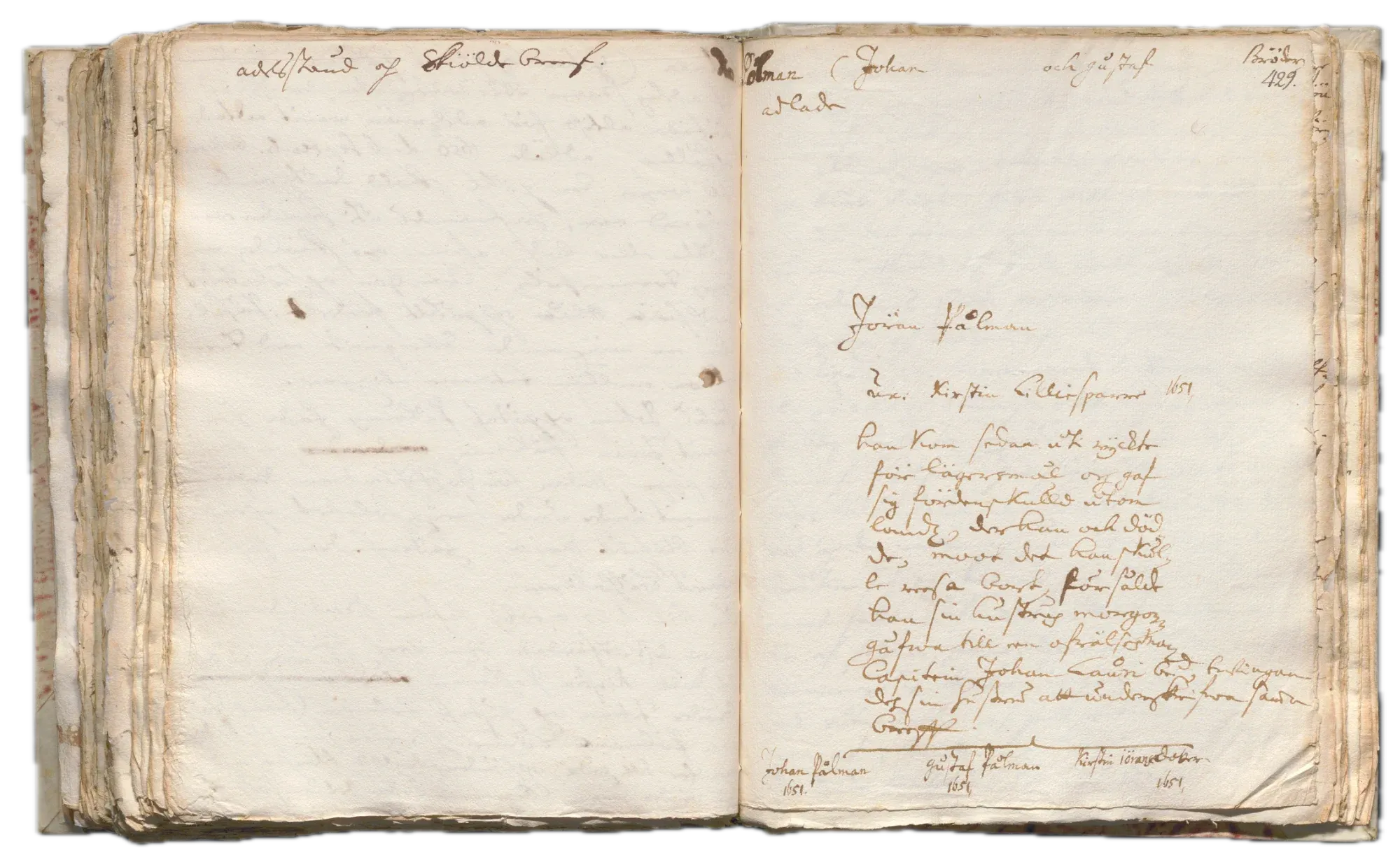
The court records, read alongside his note, form a coherent picture. The Vice-Governor heard the rumour of a courtship and considered it significant enough to document even off the record. The late vicar of Bolmsö had traveled to Beata's estate and confronted the pair directly, demanding the matter be resolved by marriage or ended. Beata was first cousin to Polman's own wife, Christina Lilliesparre. The adultery, if true, was not merely a private scandal — it was a betrayal within the extended family. Christina was left behind at Ugglansryd to manage the estate her husband had stripped and fled. Polman liquidated assets, coerced his wife's signature, and left the kingdom permanently — sometime before January 1635, as the case against Beata gathered momentum in the district. It was not the behaviour of a man with nothing to fear. And his own family's genealogical record, compiled in Palmskiöld's notes on the Påhlman line, preserved the reason: lägersmål — fornication or adultery.[[27]]
None of this constitutes proof, and the record cannot take us further than this. But between a near-contemporary source naming Polman explicitly, a recorded rumour the Vice-Governor thought worth documenting, a vicar's ultimatum to the pair, and a permanent and hurried flight — the cumulative weight is not easily dismissed. History rarely offers more than this.
What the archive cannot say is who gave the order, or whether Beata acted alone. What it can say is that a child existed, that it was hidden, and that the man named in the record as the most likely father was already gone.
Polmanarkivet is sustained by its Stewards
We have made this article free because we believe this history belongs to everyone. If this work matters to you, consider becoming a Steward of the Archive. Your support funds the research, preserves the collection, and ensures these stories are never lost again.
Become a StewardThis article is a companion to The Flight of Jöran Polman, which covers Polman's departure from Sweden, the sale of his wife's morning gift, and his subsequent years abroad.
[[1]]: Västbo Häradsrätt. Court Protocol regarding Beata Lilliesparre, May 3, 1633. Göta Hovrätt – Advokatfiskalen Jönköpings län (E, F, G, H, N) EVIIAAAC:8 (1633–1649), image 240, pp. 8–11. ArkivDigital.
[[2]]: Ibid.
[[3]]: Ibid.
[[4]]: Ibid.
[[5]]: Gustaf Elgenstierna, Den introducerade svenska adelns ättartavlor, vol. V (Stockholm: P. A. Norstedt & Söners Förlag, 1930), s.v. "Påhlman, nr 501."
[[6]]: Västbo Häradsrätt. Court Protocol, September 16–17, 1633. Göta Hovrätt – Advokatfiskalen Jönköpings län (E, F, G, H, N) EVIIAAAC:8 (1633–1649), images 300–310, pp. 20–23. ArkivDigital.
[[7]]: Västbo Häradsrätt. Court Protocol regarding Beata Lilliesparre, September 16–17, 1633. Göta Hovrätt – Advokatfiskalen Jönköpings län (E, F, G, H, N) EVIIAAAC:8 (1633–1649), images 300–310, pp. 20–23. ArkivDigital.
[[8]]: Ibid.
[[9]]: Ibid.
[[10]]: Västbo Häradsrätt. Court Protocol regarding Beata Lilliesparre, May 3, 1633. Göta Hovrätt – Advokatfiskalen Jönköpings län (E, F, G, H, N) EVIIAAAC:8 (1633–1649), image 240, pp. 8–11. ArkivDigital.
[[11]]: Västbo Häradsrätt. Court Protocol regarding Beata Lilliesparre, September 16–17, 1633. Göta Hovrätt – Advokatfiskalen Jönköpings län (E, F, G, H, N) EVIIAAAC:8 (1633–1649), images 300–310, pp. 20–23. ArkivDigital.
[[12]]: Ibid.
[[13]]: Ibid.
[[14]]: Ibid.
[[15]]: Ibid.
[[16]]: Västbo Häradsrätt. Court Protocol regarding Beata Lilliesparre, October 1635. Göta Hovrätt – Advokatfiskalen Jönköpings län (E, F, G, H, N) EVIIAAAC:8 (1633–1649), images 560–570, pp. 32–35. ArkivDigital.
[[17]]: Ibid.
[[18]]: Ibid.
[[19]]: Ibid.
[[20]]: Ibid.
[[21]]: Ibid.
[[22]]: Ibid.
[[23]]: Ibid.
[[24]]: Ibid.
[[25]]: Ibid.
[[26]]: Ibid.
[[27]]: Elias Palmskiöld, Genealogiae Sveo-gothicae, Tomus XLI, Litt. P, Pars 3, MS Palmsk. 232, p. 425, Palmskiöldska samlingen, Uppsala University Library, Uppsala.
[[28]]: Kungl. Maj:t. Royal Mandate to Göta Hovrätt regarding Beata Lilliesparre, October 8, 1638. Riksarkivets ämnessamlingar. Personhistoria. SE/RA/756/756.1/L/I/L 28, bildid: A0069838_00049. Riksarkivet, Stockholm.
[[29]]: Ibid.
[[30]]: Gustaf Elgenstierna, Den introducerade svenska adelns ättartavlor, vol. V (Stockholm: P. A. Norstedt & Söners Förlag, 1930), s.v. "Lilliesparre, nr 44."
[[31]]: Elgenstierna, Den introducerade svenska adelns ättartavlor, vol. V, s.v. "Påhlman, nr 501."
[[32]]: Ibid.
[[33]]: Västbo Häradsrätt. Court Protocol regarding Beata Lilliesparre, October 1635. Göta Hovrätt – Advokatfiskalen Jönköpings län (E, F, G, H, N) EVIIAAAC:8 (1633–1649), images 560–570, pp. 32–35. ArkivDigital.
[[34]]: Elias Palmskiöld, Genealogiae Sveo-gothicae, Tomus LXI, Analecta Pars 1, Litt. A–N, MS Palmsk. 252, p. 559, Palmskiöldska samlingen, Uppsala University Library, Uppsala.