"The family is stated in another source to be of Polish origin and according to legend, 12 brothers are said to have settled in different countries. The family's coat of arms has been noble."[[1]]
— Bjørn Piro, Arkivverket, 2014
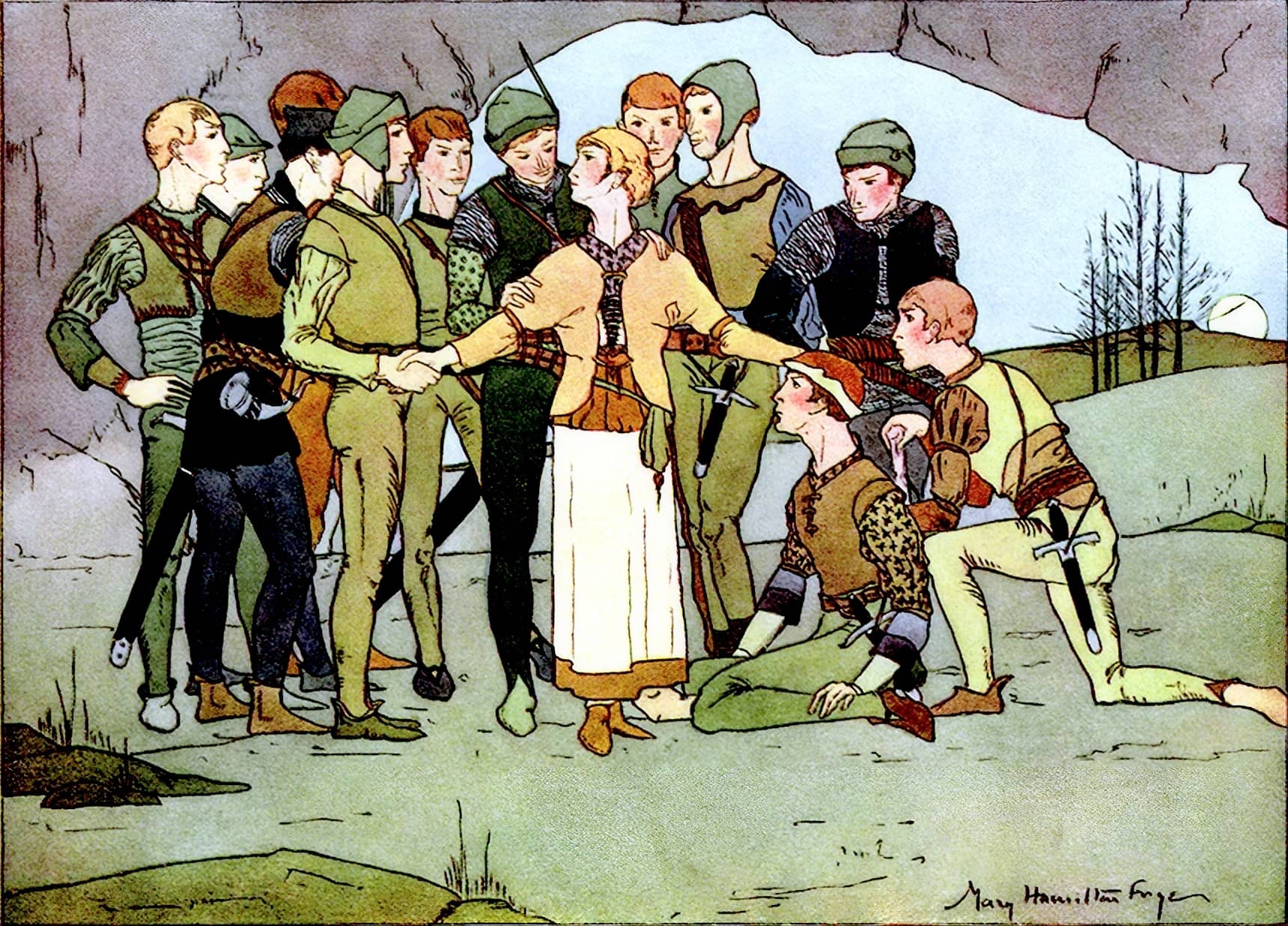
The story gives no date and names no father. Twelve brothers are said to have set out, each settling in a different country, and carrying the family name and the family arms into whatever territory received them. The obvious way to test it is against the family's own genealogical table: look for twelve sons in a single generation, tied to a family estate somewhere in the county of Ravensberg.
They are not in any table that survives.
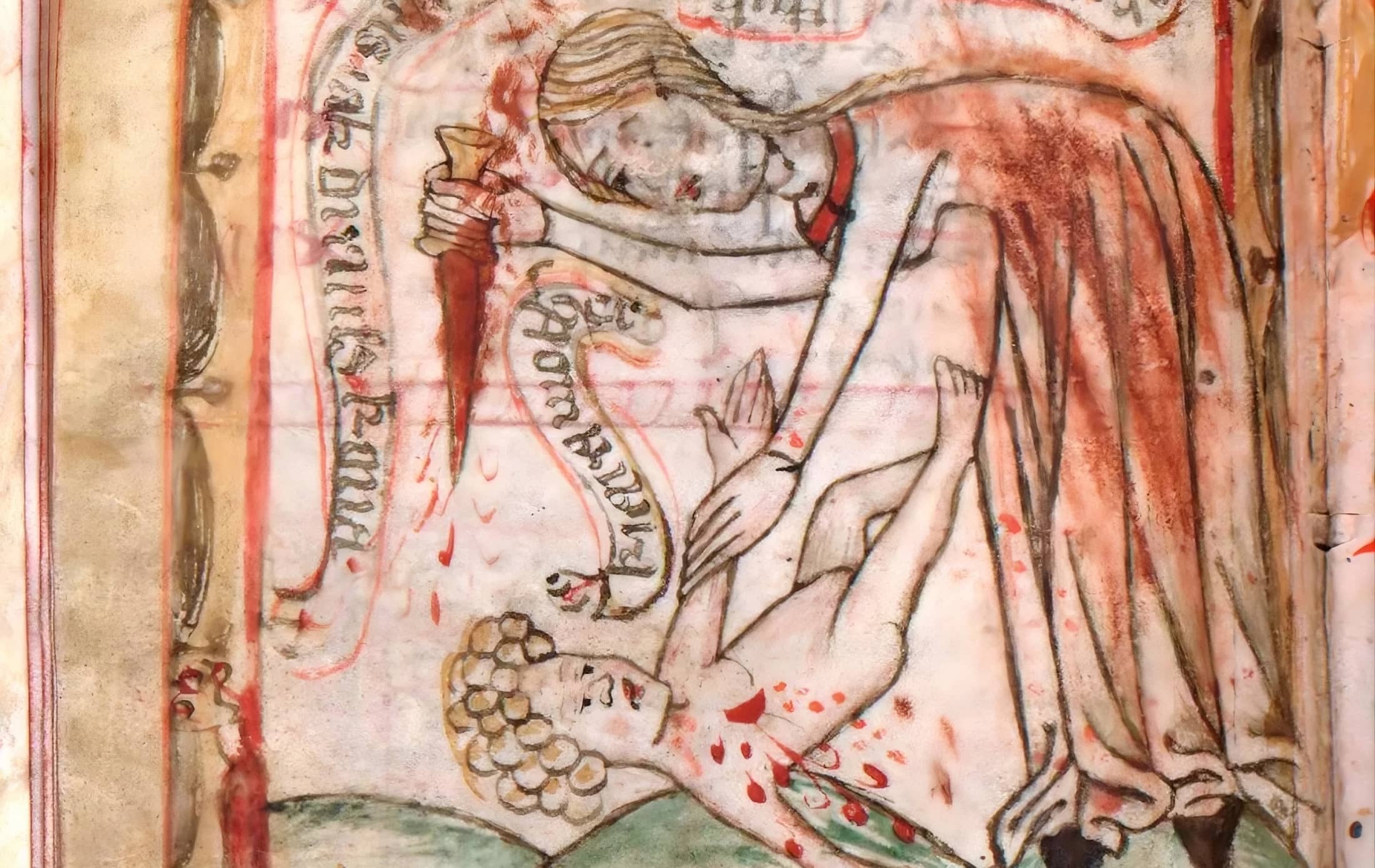
In the Norse poem Rígsþula, composed sometime between the ninth and twelfth centuries, the nobleman Jarl fathers twelve sons, each named for rank and destiny:
Burr was the eldest, and Barn second, Jóð and Aðal, Arfi, Mögr, Niðr and Niðjungr — they took up games — Sonr and Sveinn — swimming and tafl — one was called Kundr, Konr was the youngest.[[2]]
— Rígsþula, stanza 41, c. 9th–12th century
From these twelve sons, the poem says, come the families of the warrior nobility. Twelve brothers, or twelve sons founding twelve lines, recur elsewhere too: in the Genesis account of Jacob's sons, in a Grimm tale of the same number, in stories from traditions with no contact with one another. That is three traditions, unconnected to each other, all dividing a single family by the same number. The Pohlmann legend divides its own family the same way.
A Knight, a Colonel, a Governor, a Captain
The noble genealogies compiled by Gabriel Anrep in the 1860s describe the Pohlmann family as originating from an old family in Westphalia, from where it came to Poland and Livland, where it was counted, by 1690, among the old but then extinct families of the region.[[3]] Anrep tried to strip mythological elements from the genealogies he compiled. The House of Nobility would not let him. The entry that survives reflects what the House of Nobility required him to record, not an independent finding of his own.[[4]]
A specific attempt to document that antiquity surfaced in 1903, at a heraldic conference in Mitau: a genealogical table catalogued as tracing the von Pohlmann family from 1380 to 1735, a span that would qualify the family as uradel, nobility old enough to predate the fifteenth century.[[5]] The table itself has not survived in any source consulted for this article. It was exhibited, catalogued, and then it disappeared.
But a fragment of the same kind of record survives elsewhere, in worse condition. Among the filings of the Estonian Knighthood, a partial transcription of what is described as "an old, defective family tree" preserves four generations:[[6]]
I. Heinrich, Knight, in ducal service, Hereditary Lord of Erkula, married Dorothea von Schwalenberg.
II. Konrad von Pohlmann, Imperial Colonel, Hereditary Lord of Erkula, married Katharina von Sturen.
III. Hinrich von Pohlmann, Episcopal Councillor, Governor of Neuhausen in Westphalia, Hereditary Lord of Erkula, married Katharina von Born.
IV. Jürgen von Pohlmann, Captain, around 1620 at Tattomäggi.
— Acte der Estländischen Ritterschaft, c. 1852–1886
The tree was already defective when it was copied, and the line from Heinrich down to Jürgen cannot be verified. The Jürgen it names is not a stranger, though: a captain at Tuttomäggi around 1620 is how the rest of this article comes to know him.
A Grave in Hille
In the churchyard at Hille, in the county of Ravensberg in Westphalia, lies buried a Herman Pohlman, his wife, and their son Johan, born 13 June 1619.[[7]] The family owned a farm in the same parish — the so-called Meyerhof, a property that had passed to them in 1619 from a bailiff named Johann Henrichking.[[8]] Their coat of arms carried an armoured arm whose hand held a ring.[[9]]
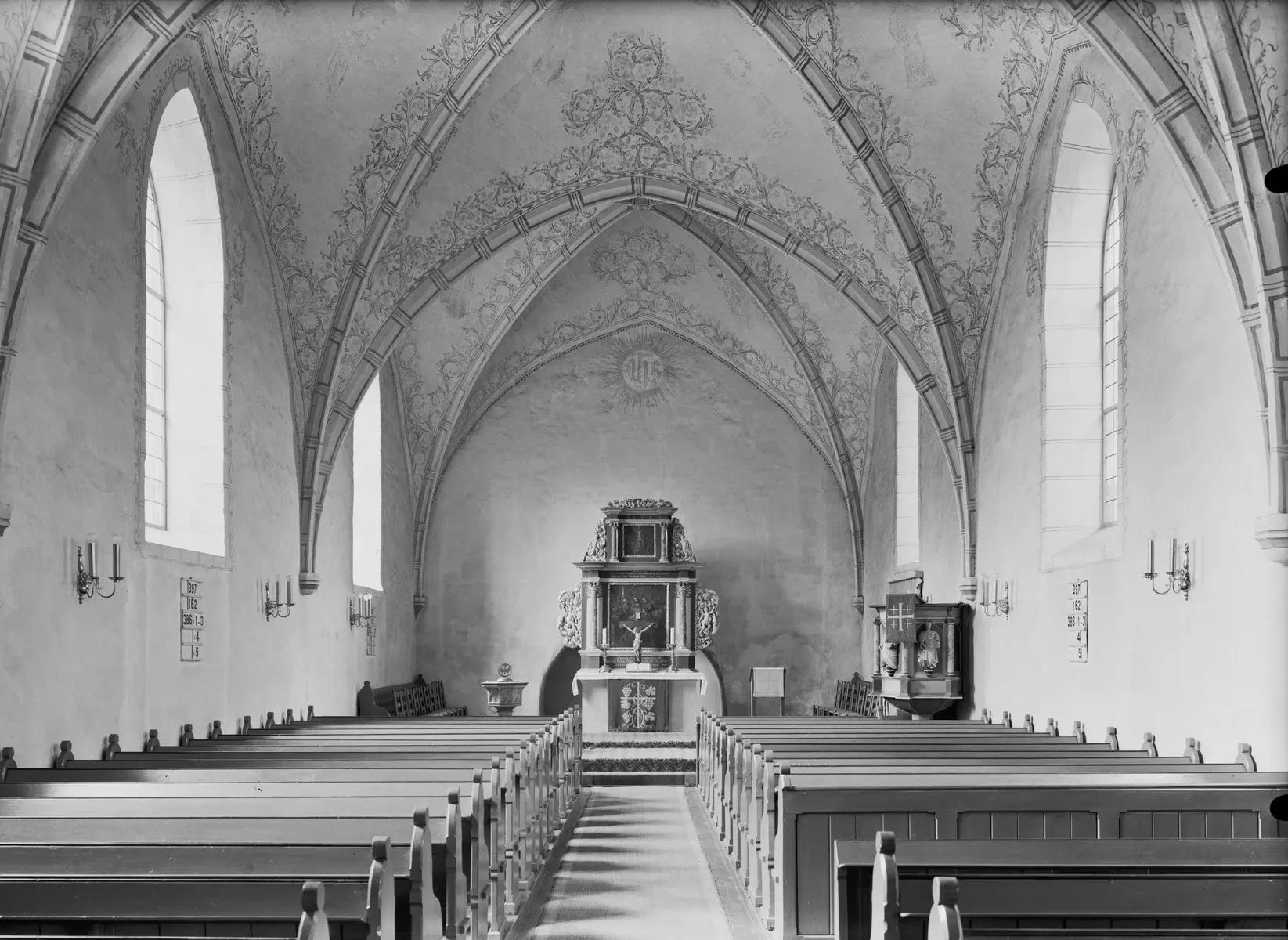
In the Hille church, a wooden panel commemorates the son who died young. Beneath a depiction of Christ on the cross stands Hermann Pohlmann with his wife, their deceased child between them. The inscription reads:
"Anno 1619 June 13th is Hermann Pohlmanns son Johann born, died 1622. I live for you, Christ, I'll die for you."[[10]]
— Inscription, Hille church, Westphalia, 1622
This is the family every later genealogy points back to. The claim appears in every major genealogical treatment of the family, compiled independently across four centuries.[[11]] The Geschlechtsbuch der Familie von Pohlmann, assembled from archival sources in the Estonian National Archives, opens its account by citing four separate scholars who all arrive at the same place.[[12]]
The Westphalian line itself persisted far longer than the genealogical literature generally acknowledges. Susanne née Pohlmann, born in 1644, married the Prussian cavalry colonel Johann Ernst Heinrich von Oeynhausen and after his death in 1722 donated the altar in the Hille church in 1725, the same church where Johan's memorial panel had hung for over a century.[[13]] The altar carried the double coat of arms of v. Oeynhausen and Pohlmann. When Susanne died in 1728 at the age of eighty-four, the Meyerhof passed to Christian Friedrich Pohlmann, her great nephew, who thereby united both Pohlmann estates in Hille under a single owner.[[14]] He was the last of the name to hold the farms. He died in 1781, having sealed his documents in 1736 with three eagles, a departure from the armoured arm the family had carried for generations. His son Christian Gottlieb Ludwig is listed in the church registers as lieutenant, then captain, then major, always without the noble prefix — until a single late entry records him as Major von Pohlmann. Whether justified or not, the chronicler notes, he could not determine.[[15]] Christian Gottlieb Ludwig died in 1819.
The arms recorded in the definitive compendium of Westphalian nobility were not drawn from Westphalian sources at all. Max von Spießen compiled his Wappenbuch des Westfälischen Adels over decades of visits to estate archives across Westphalia, the authoritative register of the region's noble arms.[[16]] The Pohlmann family appears in it, but Spießen had taken their arms from von Klingspor's Baltisches Wappenbuch, a Baltic heraldic register.[[17]]
This story came from the archive.
Polmanarkivet is a digital archive dedicated to six centuries of Polman, Påhlman, and von Pohlmann history — researching what survived, and recovering what was buried. Become a free Member and get new research and stories like this one delivered to your inbox every month.
The Dispersal
By the middle of the sixteenth century, the family was no longer confined to Westphalia. Name-bearers appear simultaneously across the eastern Baltic, from Courland to Riga to Reval, spread too widely to have arrived there together.
In the Duchy of Courland, an Anton Poldemann — the spelling varies across documents — was serving as district clerk in Kandau by 1567. That year, Duke Gotthard von Kettler wrote to confirm him in the right to sell and transfer his lands, describing him as someone whose request he was not minded to refuse:
"We would like to ask for him to be granted the same allowance and to grant him grace, as he is an old servant and we do not want to deny him the same."[[18]]
— Duke Gotthard von Kettler, 1567
Anton's lands in Kandau would be recorded as "Polmann's Logement" in documents as late as 1620.[[19]] He was alive in 1603, when his own mortgage note records him pledging "a piece of land, my father's property" as security against a debt of one hundred marks.[[20]] His brothers Heinrich and Gotthard held land nearby; Gotthard was still being enfeoffed with land in the Selburg district as late as 1614.[[21]] Their father, also named Heinrich, had moved from Kandau to Dorpat around 1579 in the company of Colonel Barthold von Buttlar. A fourth sibling, Hermann, had gone abroad before 1605 and died before 1619; his widow, Anna Hildebrandt, was granted lifelong use of the Candau lands by Duke Friedrich of Courland.[[22]]
In Riga, a Hector Polman was serving as school rector, confirmed in ownership of the Planup estate in Livonia by the King of Poland in 1591, selling it seven years later for five thousand marks, and buried with his wife at St. Peter's Church on 25 November 1617.[[23]] In Reval, a Hermann Polemann sat as a city councillor from at least 1558; a Johannes Polmann held the same office in 1587; a Wilhelm Polmann sided with the Swedes during the Livonian War of 1600–1602.[[24]] And the reach extended further still. A Herman Pohlmann, born around 1650 — the same year the Swedish branch received its patent of nobility — settled in Norway, where he was buried at Christiania on 20 July 1723, the oldest of the family there.[[25]]
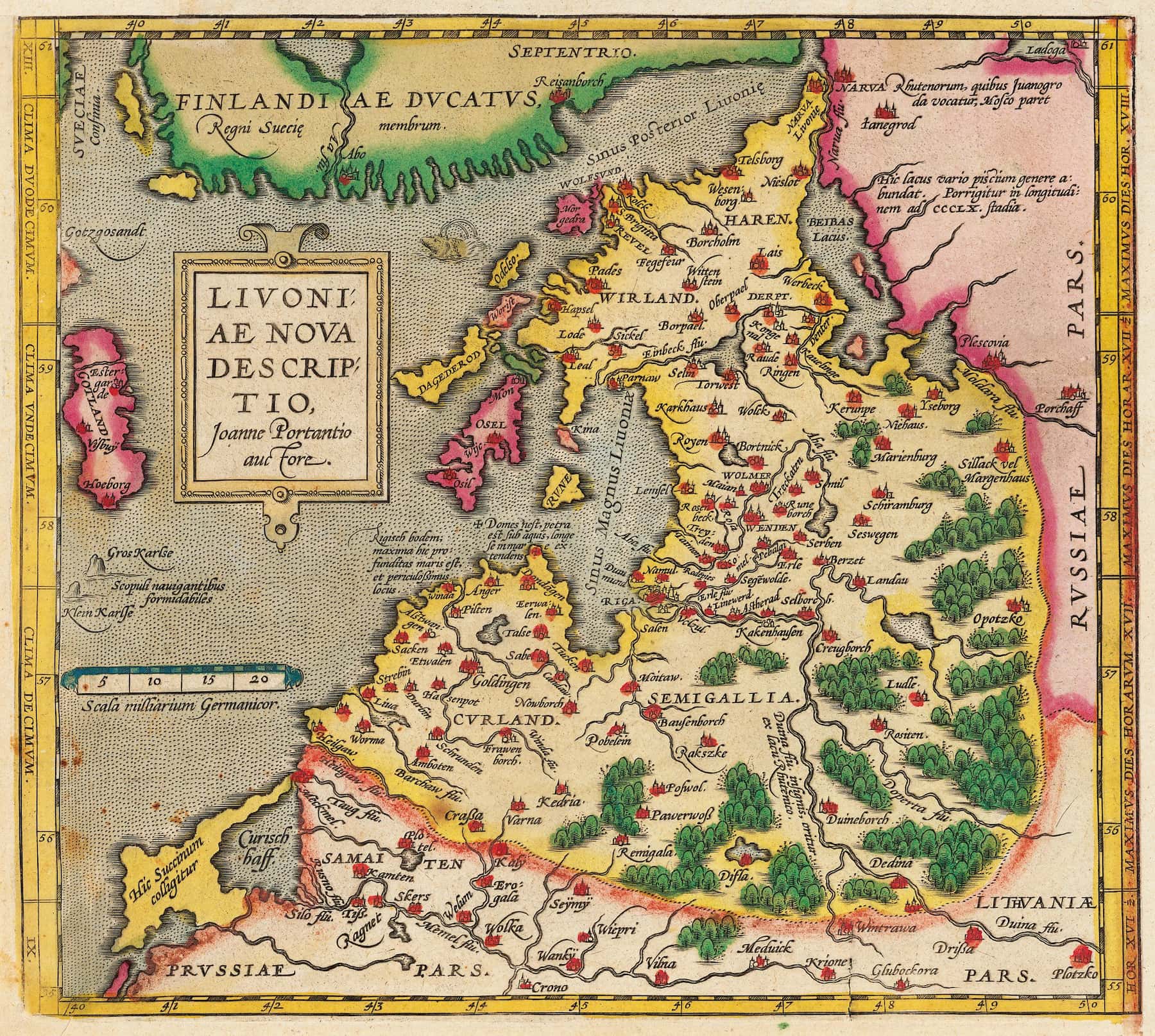
The Geschlechtsbuch asks the question directly: whether and how these figures connect to each other. The genealogical relationship "cannot be decided at this time due to a lack of records." But the Acte der Estländischen Ritterschaft, the Estonian Knighthood's own summary of the family, reaches beyond the Baltic entirely:
"The family P. originates from Westphalia. The patricians and country squires von Pohlmann participated in wars and campaigns in Spain, France, Hungary and the Netherlands, and were regarded as people of rank and knightly standing."[[26]]
— Acte der Estländischen Ritterschaft, c. 1852–1886
In 1624, in Courland, a figure recorded as Jürgen Pollmann used a coat of arms that placed three acorns directly in the shield itself.[[27]] Not above the helmet, where acorns would later become a fixed element of every recorded version of the family arms, but in the field of the shield. The same motif, differently arranged, in a different hand.
Of all these branches, one can actually be followed. The earliest confirmed patriarch in the Baltic record is Hans Polman, a county clerk serving in Padis, in St. Matthias parish in Estonia.[[28]] In October 1603, a witness appeared before the Reval City Council and testified that Hans's son Jürgen – almost certainly a different man from the Courland one – had been "truly fathered by his father Hans, official clerk to Padis, and his mother Margarete, genuinely begotten, free, and owned by no one."[[29]] It is a legal declaration of free and legitimate birth: the kind of testimony produced when a man's status is under question.
Hans's son Jürgen entered the service of Duke Karl of Södermanland, the future King Karl IX of Sweden, as his Hauptmann at Anzen in Livonia.[[30]] Several younger sons — Claus, Heinrich Johan, and Friedrich — remained in Estonia. An elder son named Jöran, born 1597, had already moved westward into Sweden.[[31]]
Which We Leave to Its Place
Jöran settled in Småland through his marriage to Christina Lilliesparre af Fylleskog, and his sons — Johan and Gustaf, who had grown up at Ugglansryd in Ryssby parish — came of age as Swedish officers.[[32]] When they sought recognition as Swedish nobility in the middle of the seventeenth century, they brought with them a claim: that they descended from an old noble line out of Westphalia, that their ancestors had always been regarded as noblemen, and that the lineage was ancient.
The patent of nobility Queen Kristina issued on 16 September 1650 acknowledges the claim without confirming it:
"Wherefore, although they themselves allege that they descend from a noble line out of Westphalia, and that their ancestors have always been esteemed and held as noblemen and called themselves Pohlmän, which We leave to its place, as such things, through the difficulties of the times and the great changes that have occurred in those places, are mostly lost and obscured, it is nevertheless not unknown to Us the faithful and good services which this Johan and Gustaf Påhlman's Father and Grandfather have shown the Crown of Sweden."[[33]]
— Queen Kristina, Patent of Nobility, 1650
"Which We leave to its place"
Kristina was not saying the claim was false. She was saying the documents that would prove it were gone, most likely consumed by the same run of wars, the Livonian War, decades of conflict over Livonia and Estonia, the Thirty Years War barely two years concluded, that had left records across the region "mostly lost and obscured." She granted the rank on other grounds: service she could actually point to. That service had a paper trail of its own. Jürgen received Sääksmäki in 1604, a right over Tuttomäggi in 1615, and the estate of Öthel by 1631. The brothers were ennobled anyway, under the name Påhlman, and introduced into the Swedish House of Nobility under number 501.[[34]]
The arms the patent specified carried "an armored arm, holding in the hand a ball or shot."[[35]]
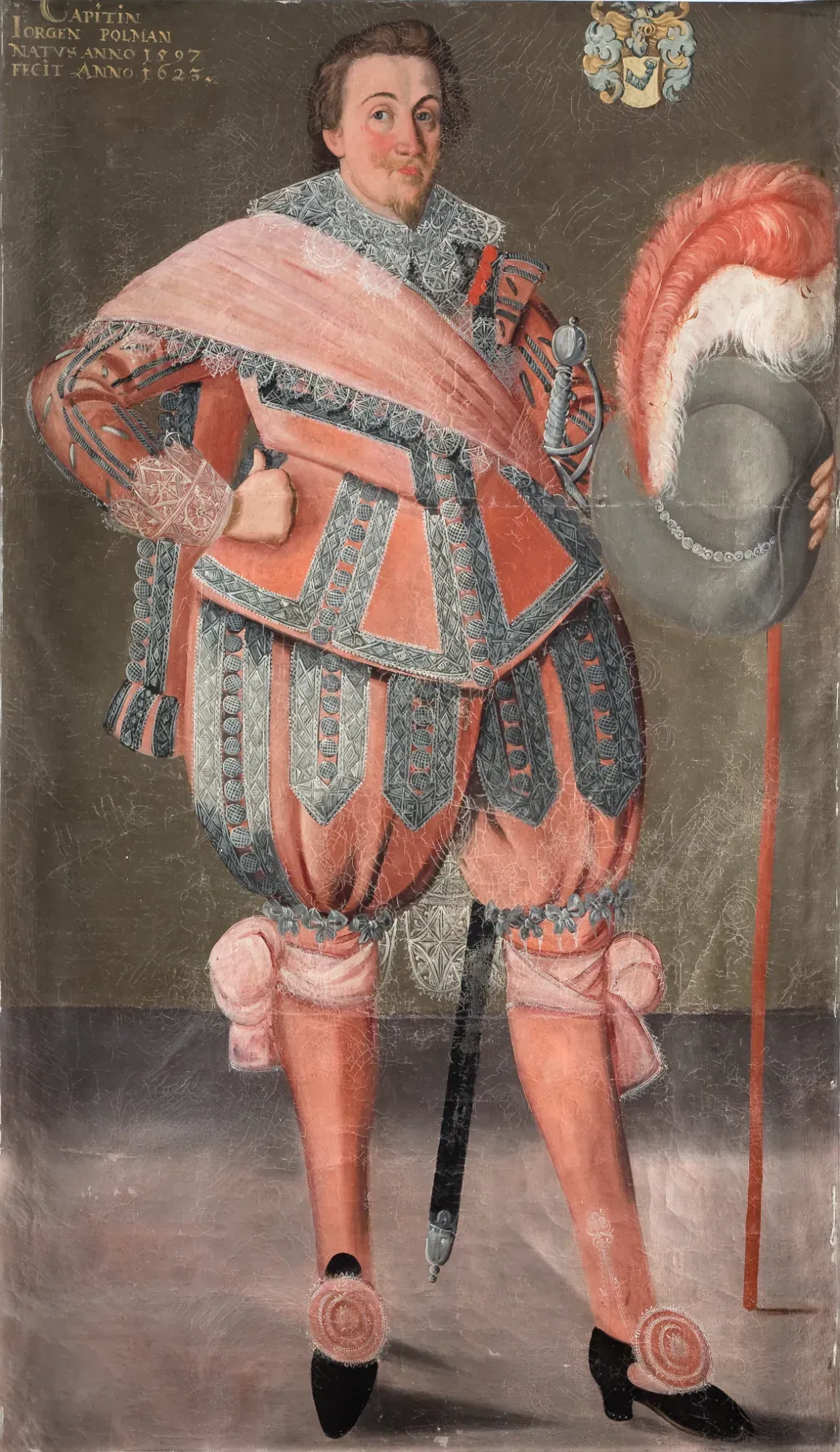
In 1623, Jöran Polman the Younger sat for a portrait now hanging at Skokloster Castle. His sons would become the first Påhlmans. The coat of arms in his portrait shows an armoured arm whose hand holds a ring.[[36]] The oldest surviving seal of the Pohlmann lineage, pressed by Jürgen Polman the Elder onto a paper document in 1627 and now held in the Estonian National Archives shows the same: an armoured arm, a ring.[[37]] Within a generation, in the hands of Swedish heraldic authority, both had become a ball. One later assessment offers the simplest explanation: "That a ring can be mistaken for a bullet is not surprising, so if the story is true, it is possibly the family of which the Påhlman family is a branch of."[[38]]
Obliged to Properly Document
A century later, Jürgen Polman's son Claus, who had remained at Oethel while his brother moved to Sweden, found himself before the Estonian Matriculation Commission with the same question to answer and the same absence of proof.
When the Estonian Noble Matriculation was being established in the mid-eighteenth century, the Pohlmann family attempted to document their noble status. The Matriculation Commission's protocol of June 10, 1746, records the result: the family was "obliged to properly document what was brought forward."[[39]] The protocol of February 1754 notes that additional materials were delivered. No decision follows it in the record.[[40]]
"Obliged to properly document what was brought forward"
By 1755, the family's approach had changed. Rather than press the ancestry claim further, they submitted the one thing they could document outright: that they had owned land in Estonia since the reign of Gustaf II Adolf. The commission accepted this, decreeing on July 11, 1755:
"The Pohlmann family proves via original letters from King Gustavo Adolpho that they were already propertied here in the country at that time; thus, since the same support the notoriety of the held Jure Indigenatus, they are to enjoy these rights from Swedish times."[[41]]
— Estonian Matriculation Commission, 1755
Both branches secured recognition this way: the Swedish branch through a patent of nobility grounded in service, the Estonian branch through matriculation grounded in land tenure. In neither case was the ancestry claim itself confirmed.
Fragments
A genealogist named Richard Pohlmann — the mayor of Schlock — spent years assembling a family history that eventually catalogued 350 members of the lineage across six recorded spellings of the name: Polemann, Pollmann, Poldemann, Polmann, Bolemann, Pohlmann.[[42]] He collected drawings of coats of arms and seals. He submitted copies of documents to the archive. The editor who received them noted that the copies were "obviously very corrupted" and that collation with the originals "was unfortunately not possible at this time."[[43]]
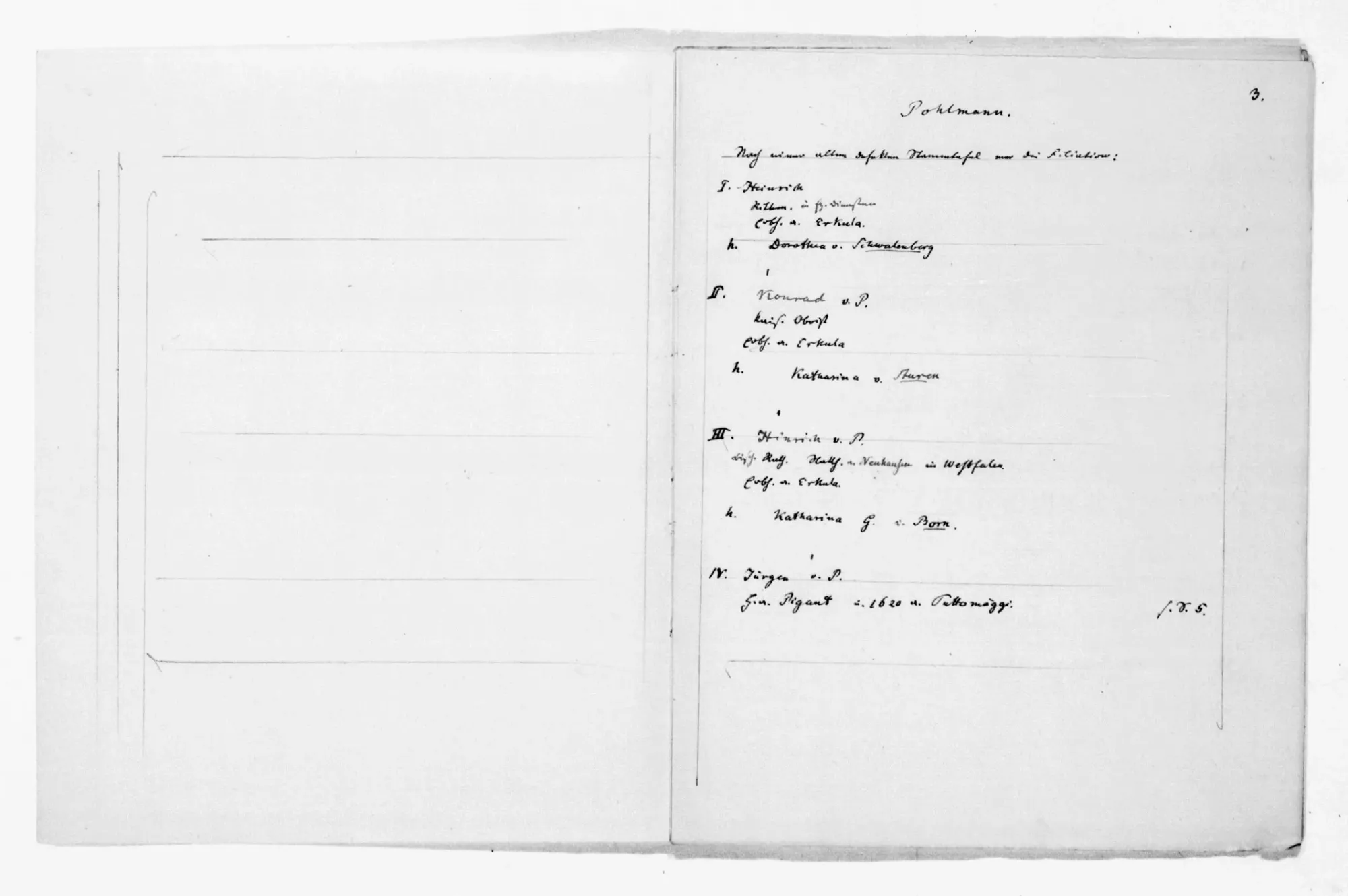
The genealogical table from 1380 was exhibited at Mitau in 1903 and has not been located since.[[44]] The defective family tree in the Estonian Knighthood's filings preserves four named generations, but the filiation cannot be verified. The margin directs the reader to a further volume that may or may not exist.[[45]] Whether the filiation in those filings corresponds to the 1380 table, or to something else entirely, cannot be determined from the surviving record.
Whether twelve brothers set out from Westphalia cannot be determined at this time. The surviving record neither confirms it nor rules it out. Kristina left the question to its place in 1650. The Estonian commission fell silent on it in 1754. The table that might have settled it, exhibited at Mitau in 1903, has not been located since.
What the record does contain is a name repeated across three centuries and four territories: Westphalia, Livonia, Estonia, Sweden. A single Norwegian burial register suggests a fifth. Whether that repetition is twelve brothers, coincidence, or something the record simply hasn't kept, is left to the reader.
This article was produced with AI assistance. Transcription and translation of primary sources was carried out using Gemini 3.0 Pro, with outputs cross-checked across multiple models. The author used an LLM to support research synthesis and drafting, directed the process throughout, and verified all factual claims. For a full account of how Polmanarkivet uses AI, see our AI Policy.[[1]]: Piro, Bjørn. "Notarius Publicus Herman Pohlmann, Begr. 20.Jul.1723." Arkivverket. October 14, 2014. https://forum.arkivverket.no/topic/192706-notarius-publicus-herman-pohlmann-begr-20jul1723/.
[[2]]: Rígsþula, stanza 41, in Codex Wormianus (AM 242 fol), c. 9th–12th century. Translation from: Dronke, Ursula, ed. The Poetic Edda. Vol. 2, Mythological Poems. Oxford: Oxford University Press, 1997.
[[3]]: Anrep, Gabriel. Svenska Adelns Ättar-Taflor: Von Nackreij – Skytte. Vol. 3. Stockholm: P.A. Norstedt & Söner, 1864, p. 274.
[[4]]: Elgenstierna, G. "J. Gabriel Anrep." In Svenskt biografiskt lexikon, band 2, sida 55. Stockholm: Riksarkivet, 1920. https://sok.riksarkivet.se/sbl/artikel/18732.
[[5]]: von Stackelberg, Otto Magnus. Genealogisches Handbuch Der Estländischen Ritterschaft. Vol. 1. Görlitz: Starke, 1931, pp. 248–249.
[[6]]: "Acte der Estländischen Ritterschaft betreffend die adelige Familie Pohlmann" [Files of the Estonian Knighthood concerning the noble family Pohlmann], ca. 1852–1886, Eestimaa rüütelkond, EAA.854.3.568, Rahvusarhiiv [National Archives of Estonia], Tartu.
[[7]]: Elgenstierna, Gustaf. Den introducerade svenska adelns ättartavlor. Vol. 6. Stockholm: P. A. Norstedt & Söners förlag, 1930.
[[8]]: Horst, Karl Adolf von der. Die Rittersitze Der Grafschaft Ravensberg Und Des Fürstentums Minden. Berlin: J. A. Stargardt, 1894, pp. 151–153.
[[9]]: Ibid.
[[10]]: Ibid.
[[11]]: Bergström, Otto, and Fredrik Ulrik Wrangel. Svenska Adelns Ättartaflor Ifrån År 1857 D. 2 von Nackreij-Örnskiöld. Vol. 2. Stockholm: Norstedt, 1900; Elgenstierna, Den introducerade svenska adelns ättartavlor, vol. 6; Riddarhuset. "Påhlman – Minerva," 2020. https://minerva.riddarhuset.se/att/pahlman/.
[[12]]: "Geschlechtsbuch der Familie von Pohlmann" [Genealogy Book of the von Pohlmann Family], 19th–20th century, Eestimaa rüütelkond, EAA.854.3.284, Rahvusarhiiv [National Archives of Estonia], Tartu.
[[13]]: Horst, Die Rittersitze Der Grafschaft Ravensberg, pp. 151–153.
[[14]]: Ibid.
[[15]]: Ibid.
[[16]]: von Spießen, Max, ed. Wappenbuch des Westfälischen Adels. 2 vols. Görlitz: C.A. Starke, 1901–1903. Band 2, Tafel 247.
[[17]]: Ibid., citing Klingspor, Carl Arvid. Baltisches Wappenbuch. Stockholm, 1882.
[[18]]: Jahrbuch für Genealogie, Heraldik und Sphragistik 1897. Mitau: J. F. Steffenhagen u. Sohn, 1898, p. 83. https://hdl.handle.net/10062/23187.
[[19]]: Ibid., p. 82.
[[20]]: Ibid., p. 84.
[[21]]: "Geschlechtsbuch der Familie von Pohlmann," EAA.854.3.284, Rahvusarhiiv.
[[22]]: Ibid.
[[23]]: Ibid.
[[24]]: von Stackelberg, Genealogisches Handbuch Der Estländischen Ritterschaft, vol. 1, pp. 248–249.
[[25]]: Piro, "Notarius Publicus Herman Pohlmann," Arkivverket, 2014.
[[26]]: "Acte der Estländischen Ritterschaft betreffend die adelige Familie Pohlmann," EAA.854.3.568, Rahvusarhiiv.
[[27]]: Müller, Max. Beitrag zur baltischen Wappenkunde. Riga: E. Plates, 1931, p. 96.
[[28]]: CHC. "Påhlman, Släkt." In Svenskt Biografiskt Lexikon, edited by Bertil Boëthius, Bengt Hildebrand, and Göran Nilzén, 29:527. Stockholm: Riksarkivet, 1995–1997. https://sok.riksarkivet.se/sbl/artikel/7430; Riddarhuset. "Påhlman – Minerva," 2020.
[[29]]: Baltische Familiengeschichtliche Mitteilungen, 1934, nr 4, drawing on Reval City Archives, Council Protocol, 11 October 1603.
[[30]]: CHC, "Påhlman, Släkt," Svenskt Biografiskt Lexikon, 29:527.
[[31]]: Bergström and Wrangel, Svenska Adelns Ättartaflor, vol. 2.
[[32]]: Rosell, Johan, Magnus Bäckmark, Claes G. Ellehag, Kaj Janzon, and Gabriel Hildebrand. Riddarhusets Vapensköldar. Stockholm: Riddarhuset, 2019, p. 525.
[[33]]: "Sköldebrev för adliga ätten Påhlman, nr 501" (Patent of Nobility for the Noble Family Påhlman, No. 501), September 16, 1650. Riddarhuset (House of Nobility), Stockholm; Artefact Collection; Inventory No. 01:31; Archive ID 11-1398. https://minerva.riddarhuset.se/foremal/pahlman-skoldebrev-skoldebrev-23014/.
[[34]]: Riddarhuset. "Påhlman – Minerva," 2020.
[[35]]: "Sköldebrev för adliga ätten Påhlman, nr 501," September 16, 1650, Riddarhuset.
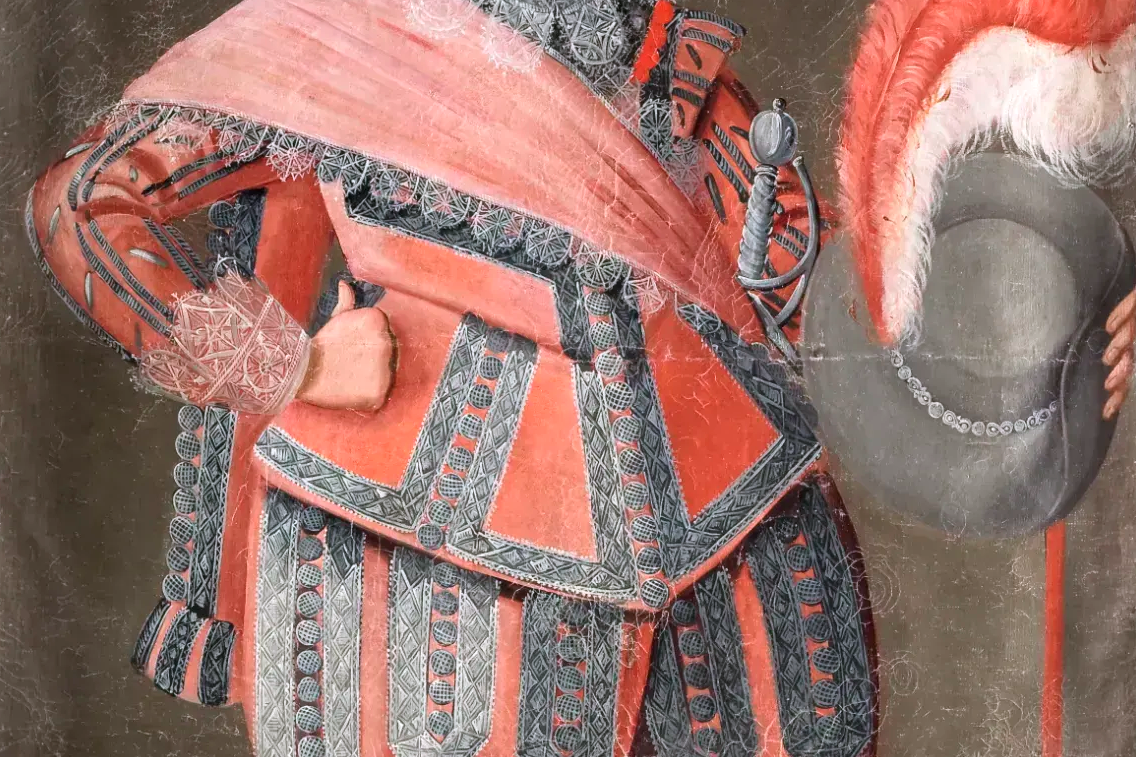
[[36]]: Georg Günther Kräill von Bemeberg (1584–1641), Jörgen Pålman, f. 1597, kapten, 1623, tempera on canvas. Photo by Jens Mohr, Skokloster Castle/SHM (CC BY).
[[37]]: "Geschlechtsbuch der Familie von Pohlmann," EAA.854.3.284, Rahvusarhiiv.
[[38]]: Rosell et al., Riddarhusets Vapensköldar, p. 525.
[[39]]: "Geschlechtsbuch der Familie von Pohlmann," EAA.854.3.284, Rahvusarhiiv.
[[40]]: Ibid.
[[41]]: Ibid.
[[42]]: Jahrbuch für Genealogie, Heraldik und Sphragistik 1897, p. 82.
[[43]]: Ibid.
[[44]]: von Stackelberg, Genealogisches Handbuch Der Estländischen Ritterschaft, vol. 1, pp. 248–249.
[[45]]: "Acte der Estländischen Ritterschaft betreffend die adelige Familie Pohlmann," EAA.854.3.568, Rahvusarhiiv.

Polmanarkivet is sustained by its Stewards
We have made this article free because we believe our family history belongs to everyone. If you value this work, please consider becoming a Steward of the Archive. Your annual contribution ensures these stories are never lost again.
Become a Steward